
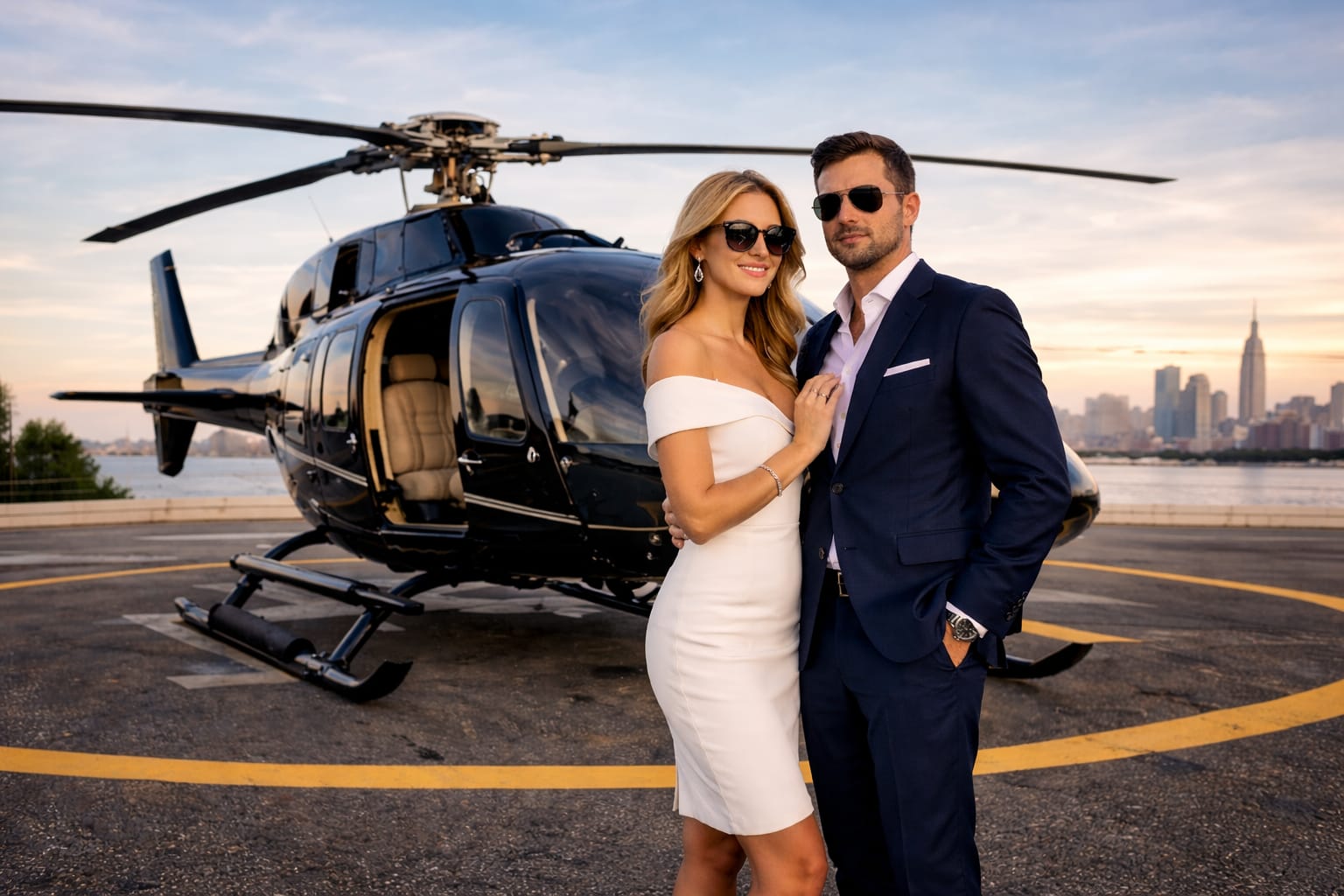
This article explains why private helicopters remain essential for high-end aerial film production, even as drones become more common. It breaks down which cinematic shots helicopters deliver better (long continuous takes, fast repositioning, stable motion at speed), why New York airspace and urban wind conditions can limit drone workflows, and how helicopter aerial cinematography supports professional camera systems and production reliability. It also connects NYC helicopter tours and New York helicopter tours to operational experience flying safely in NYC’s complex environment.
A practical, production-first look at helicopter aerial cinematography in New York
Drones are everywhere now, they made aerial coverage accessible, but when a production needs cinematic aerial work, shots that carry the same polish and control as the rest of the project re-enter the conversation around private helicopters.
Aerial Film Production isn’t “getting in the air”
Altitude is most definitely not the primary variable. Aerial Film Production is more about movement, speed, continuity, stability, and the ability to repeat the same path until the shot is right. That’s why serious teams still use helicopters as a platform, because they can deliver a longer, cleaner canvas without the stop-start rhythm that can creep into drone workflows.
Helicopter Aerial Cinematography wins on continuity
The most expensive thing on a set isn’t the camera. It’s time.
Drones tend to introduce natural breaks:
- batteries
- wind limits
- resets
- repositioning
- tiny variations that force another take
Those breaks are fine for many projects, but when the shot needs one long glide, perfectly timed to light Helicopter Aerial Cinematography earns its place: long, continuous takes with stable motion that keeps perspective consistent across distance..
NYC makes drones harder than people admit
New York is not a forgiving environment for aerial work. It’s dense, regulated, and windy in ways that don’t show up on a weather app.
Between buildings, wind can behave like a corridor, changing quickly, creating turbulence, forcing constant correction. Add the operational realities of a major city and you get a workflow where drones can be constrained by:
- location limitations
- tight airspace considerations
- crowded environments
- narrow windows where conditions cooperate
None of that means drones aren’t useful in NYC. It means they aren’t always the cleanest primary tool for a sequence that must be repeatable and consistent.
This is why helicopter platforms still show up in NYC production planning: they support a higher level of control when variables stack up.
The “shot types” helicopters are built for
Here’s the simple field guide, where helicopters are used consistently:
- Skyline arcs and reveals: clean, sweeping movement that doesn’t feel “operated”
- River-to-city transitions: long paths where continuity matters more than proximity
- High-speed lateral moves: dynamic motion that stays stable and intentional
- Wide establishing shots with momentum: the city feels alive, not frozen
- Light-chasing sequences: you can stay in the window and keep trying
Drones can do some of this, depending on conditions. Helicopters can do it with fewer compromises when scale and timing matter.
Payload flexibility is still a real constraint
There is still a ceiling on what you can fly comfortably and consistently, especially when you’re trying to match the visual standard of the rest of the project.
Helicopter platforms allow more flexibility with professional systems, and that matters when:
- you need higher-end camera packages
- you need robust stabilization
- you need consistent performance across a longer window
Why tours matter (and why it’s not a detour)
Here’s the connection most people miss: operating in New York is the hard part.
Teams that run New York helicopter tours are flying in that environment constantly, managing routes, timing, safety margins, and the realities of NYC airspace day after day. That operational experience translates directly into production support: planning, communication, and disciplined execution.
In other words, tours aren’t just sightseeing. They’re evidence of a system that can operate reliably in a complex city.
Serious crews don’t pick sides
High-level productions don’t debate “drones vs helicopters.” They plan sequences.
A smart modern approach looks like this:
- drones for tight, low, controlled moments when the environment cooperates
- helicopters for long, dynamic, continuity-heavy movement
- a shot list designed to leverage both instead of forcing one tool to do everything
That’s how you get variety without inconsistency.
The real reason private helicopters are still used
Private helicopters remain in the toolkit for one reason: they reduce creative compromise when the shot has to land.
They give productions:
- continuity
- speed and repositioning
- stable motion at scale
- the ability to chase light and timing
- an operational structure designed for repeatability
That’s why serious productions still use private helicopters, especially in New York.
 Rana ALiyan